1.086/1.861 Physics and Engineering of Renewable Energy Systems (Spring 2026)
Course description
Introduction to renewable energy generation in the context of the energy grid system. Focuses on computational analysis of energy systems. Topics include the energy grid and energy markets; fossil fuel generation; wind, solar, hydroelectric, and ocean energy; and energy storage. Tools, including computational models of wind energy generation and energy forecasting algorithms, introduced. Final project focuses on the development of low-carbon, low-cost energy systems. Students taking graduate version complete additional assignments.
Teaching responsibilities
- Delivered a lecture on solar and wind energy forecasting
- Held weekly office hours (two per week) to provide support on problem sets and lecture material
- Designed and grading four problem sets
1.61/1.061/1.061A Transport Processes in the Environment (Fall 2025)
Course description
Introduces mass transport in environmental flows, with emphasis on river and lake systems. Covers derivation and solutions to the differential form of mass conservation equations. Topics include molecular and turbulent diffusion, boundary layers, dissolution, bed-water exchange, air-water exchange, and particle transport. Meets with 1.061A first half of term. Students taking graduate version complete additional assignments.
Teaching responsibilities
- Delivered two lectures on diffusion and random-walk modeling
- Held two office hours each week to support students with problem sets and lecture material
- Designed and graded a problem set on turbulent diffusion
- Developed and taught an undergraduate laboratory module on particle advection and diffusion
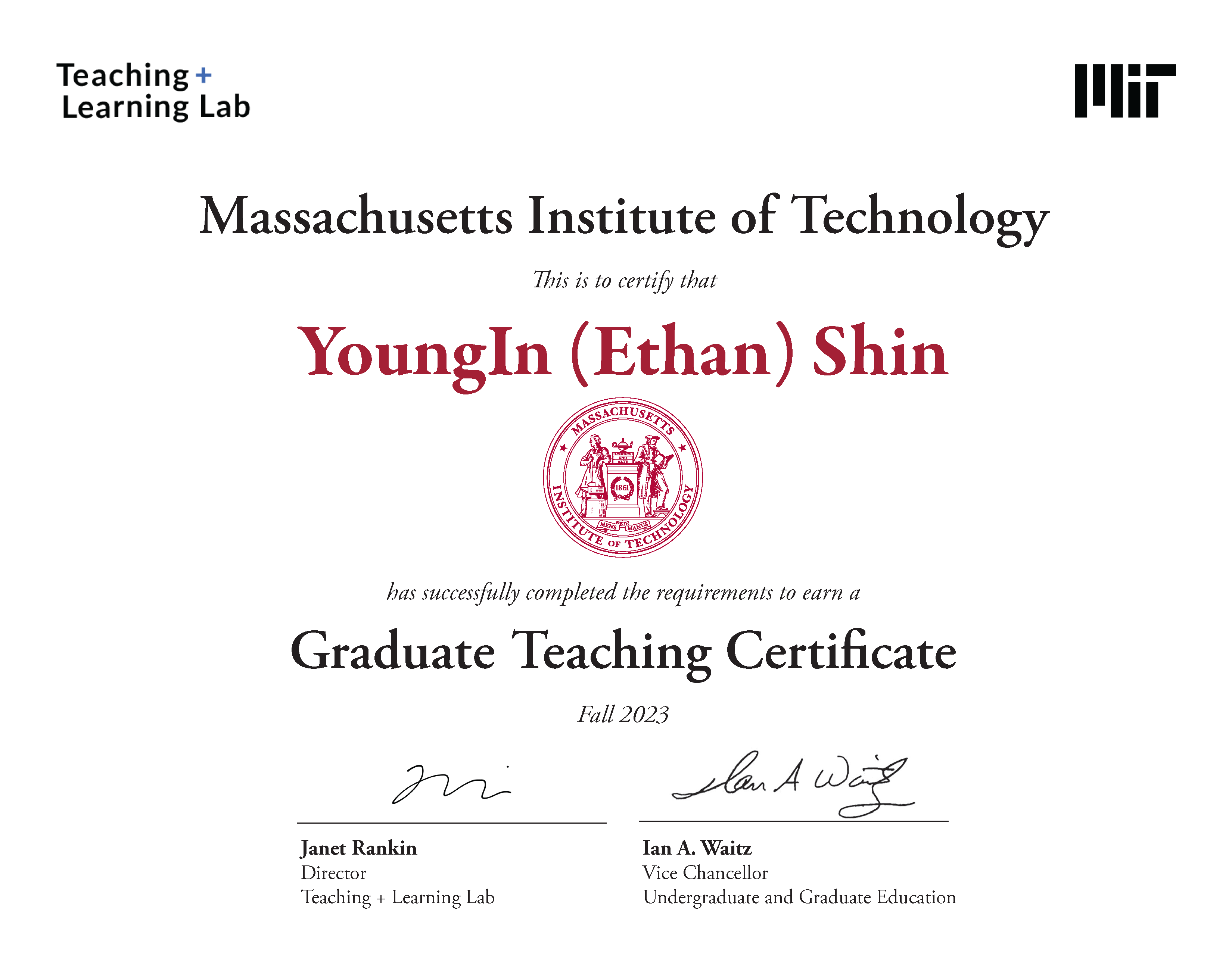
Graduate Teaching Certificate (Fall 2023)
Completion of all four Grad Teaching Development Tracks (equivalent to the Kaufman Teaching Certificate Program).